Google no longer sends every searcher to a website. Increasingly, it answers legal questions directly through AI Overviews, featured snippets, local packs, and other zero-click search experiences. That changes one of the core assumptions behind search marketing for lawyers: ranking #1 no longer guarantees website traffic.
Law firms that continue measuring SEO by clicks alone may think they’re losing visibility when, in reality, search itself has changed. Search marketing for lawyers is not dead. It’s just different. Success today is less about driving every searcher to your website and more about being visible wherever prospective clients are making decisions, whether that’s an AI-generated answer, the Local Pack, or your website itself.
Why Zero-Click Search Matters More for Law Firms Than Other Businesses
First, it helps to name the problem. Zero-click search means a person finds what they need on the results page and never visits another site. Research on Google’s AI summaries has already shown that users are less likely to click on links when the AI gives them what feels like a full answer. You can see that pattern in studies of how people behave around AI summaries in search results, such as this research on reduced clicks when AI summaries appear.
For a law firm, that shift hits in a few ways. Fewer people click through to your site to read your FAQ pages. Fewer people fill out contact forms. You might still “rank” on page one, but it no longer translates into the same number of leads. You pay the same or more for content and technical work, and you see less visible return. That is the emotional and financial tension many firms are feeling right now.
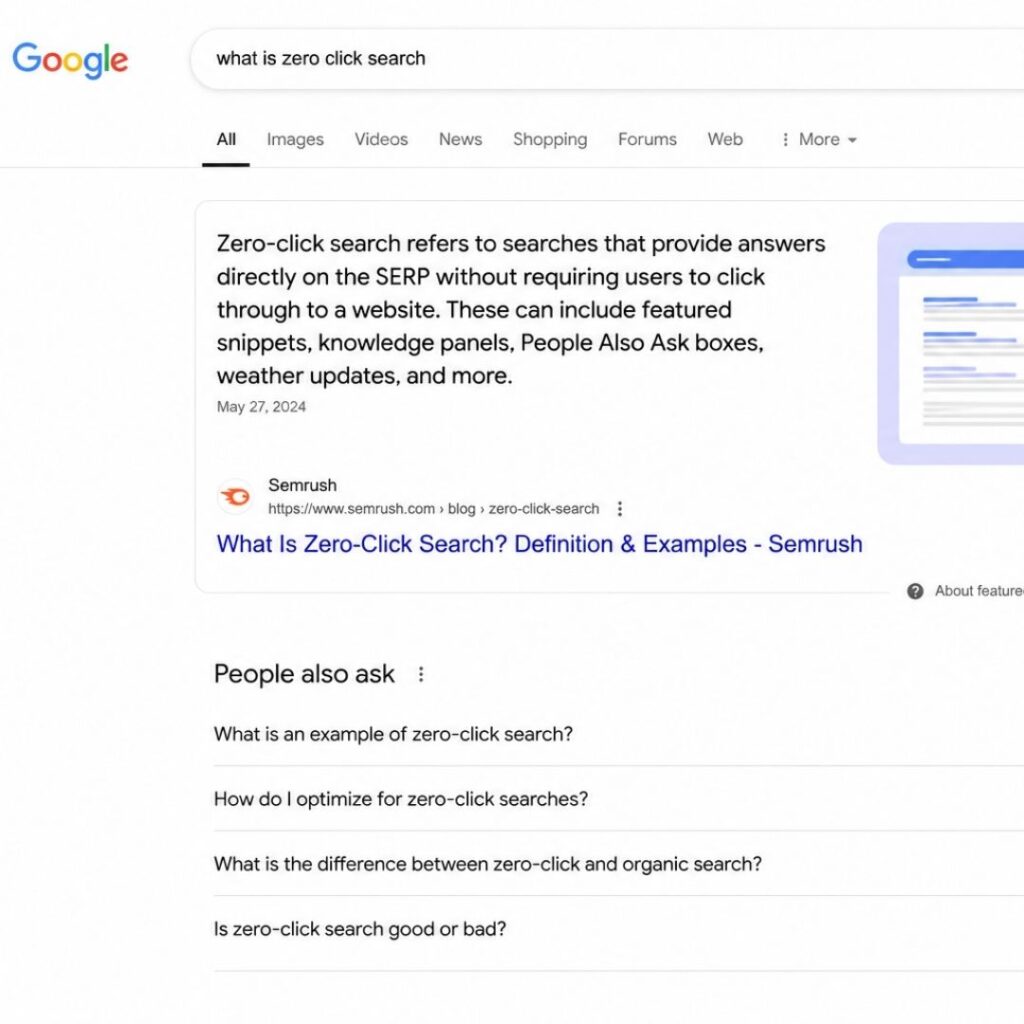
If Google is trying to answer everything right on the results page, where do lawyers still fit in? The answer is in the gaps. AI can summarize general legal information, but it cannot replace specific advice tied to a person’s facts, jurisdiction, or risk tolerance. Your job is to make it very easy for search engines and AI systems to understand when a question crosses the line from “general info” to “I need a lawyer now” and to treat your firm as a trusted source when that happens.
The Impact of Zero-Click Search on Local Results
When people talk about zero-click search, AI Overviews get most of the attention. But law firms have been competing in zero-click search results for years.
Think about how people search for an attorney. They often call directly from a Google Business Profile, read reviews without visiting a website, check office hours, get directions from Google Maps, or compare firms in the Local Pack. Others find answers in featured snippets or a firm’s Knowledge Panel and never click through at all.
None of those interactions are necessarily bad. In many cases, they’re exactly what you want. The challenge is recognizing that search marketing for lawyers is no longer just about earning website traffic. It’s about showing up wherever prospective clients are making decisions, whether that’s your website, Google’s local results, or an AI-generated answer.
How AI Is Reshaping Search Marketing for Lawyers
Think of your old search strategy as mostly about getting blue links clicked. Today, your strategy has two layers. You still want human clicks, but you also want AI systems to quote, reference, and rely on your content when they build their answers.
AI systems like clear direction. They need to be told what a page is about, who it is for, and what action matters. State agencies working on digital content for AI have already started to share that “AI loves to be told what to do,” meaning it responds well to structured, explicit guidance.
In practical terms, that means your legal content and site structure need to explain legal topics in plain language that matches how real people search. They need to answer related questions in a structured way, not scattered across dozens of thin pages. Your website should clearly highlight your experience, location, and case types in language that AI systems can easily quote.
That also means investing in your attorney profiles, not just your practice area pages. Complete attorney bios with bar admissions, representative matters, speaking engagements, publications, and other professional credentials help establish authority for both search engines and AI systems. Increasingly, they’re evaluating the people behind the content as much as the law firm itself.
Imagine two firms that both handle car accidents. One has a single long page filled with jargon and generic promises. The other has a well organized hub that answers questions relevant to your practice area. Queries like:
- “What should I do right after a car accident?”
- “How long do I have to file a personal injury claim in Illinois?”
- “Can I be deported after a DUI?”
- “How is child custody decided?”
Answer questions with clearly defined sections. You might even answer with short summaries at the top and detailed explanation in a collapsible accordion or below the fold. That is the heart of legal search marketing in the AI era. You are not just trying to rank, you are trying to become the source that both humans and machines trust when the questions really matter.
How Zero-Click Search Affects Client Acquisition
Some attorneys hope this is a passing fad. The risk is that while you wait, your competitors quietly adapt. They start appearing in AI summaries. Their brand becomes what people see and hear first. Even if the AI still lists multiple sources, the impression that they are “the” answer sticks.
Financially, you could see a slow erosion of case volume that is hard to reverse later. Emotionally, you could end up feeling backed into buying more paid ads just to keep your doors open, even if your organic presence used to be strong. Strategically, you could lose ground in practice areas you care about, as others become the “default” answers in your market.
The good news is that you do not need to start from scratch. You can repurpose much of your existing content and authority. You just need to refocus it around how AI and modern search actually work today.
Traditional SEO vs. GEO
To make this more concrete, it helps to compare traditional SEO to an updated, generative-engine-focused approach for search marketing for lawyers. The goal is not to abandon what worked before, but to evolve it.
| Area | SEO Focus | GEO & AI SEO Focus |
|---|---|---|
| Primary Goal | Increase organic clicks and traffic to the site | Be cited and used in AI summaries, while still capturing high intent clicks |
| Content Style | Many separate pages targeting narrow keywords | Topic hubs that fully answer a cluster of related questions in one place |
| Structure | Headings for humans, basic on page optimization | Clear headings, FAQ sections, and structured data that tell AI what each part covers |
| Measurement | Traffic volume, rankings, form fills | Leads, branded searches, mentions in AI answers, and quality of consults |
| Voice & Authority | General legal information, often generic in tone | Plain language answers with clear jurisdiction, experience, and next steps |
| Risk of Zero Click | Often ignored or treated as a minor issue | Accepted as the new normal, with focus on owning “hire a lawyer” moments |
Seen this way, the shift is from chasing volume to owning intent. You want to be present wherever someone is moving from curiosity to action.
How to Update Your Law Firm Search Marketing to Win More Cases in a Zero-Click Search World
1. Turn your most important practice area into a clear “answer hub.”
Pick the practice area that drives the best cases. For many firms that might be car accidents, divorce, DUI, or medical malpractice. Make one page the “hub” for that topic.
On that page, list the 10 to 20 questions you hear most often on the phone or in consults. Use those questions as subheadings. Under each subheading, write a short, clear answer in plain language, then a longer explanation for people who want more detail. Make sure you state the jurisdiction and when someone should stop trying to handle things alone and call a lawyer. Avoid publishing generic legal content that could apply anywhere. AI systems and prospective clients alike look for jurisdiction-specific guidance, so make it clear which state your advice applies to and reference the laws, courts, and legal processes relevant to your market.
This format helps both humans and AI quickly see what you cover. It also makes it easier for AI to quote you when building answers, which is the heart of generative engine optimization.
2. Make your “hire a lawyer now” signals impossible to miss.
AI tools and search engines look for clues about what kind of page they are using. Is it purely informational, or is it also about hiring counsel? You want to be very clear about when legal representation is important, without sounding pushy. On your key pages, add a short section like “When you should talk to a lawyer” with specific triggers. For example, “You were seriously injured,” “The insurance company is pressuring you to settle,” or “You were served with court papers.” Explain why those moments are risky to handle alone.
Then make it very easy to act. Include a clear invitation to call your firm, with a tap-to-call phone number in the header and footer, and a simple contact form. The clearer these signals are, the more likely it is that both humans and AI systems will associate your content with real legal help, not just basic information.
3. Align your reporting with reality, not just clicks.
In a zero-click world, success isn’t measured by website traffic alone. Search marketing for lawyers is becoming less about clicks and more about visibility. Instead of asking whether someone visited your website, ask whether your firm appeared in AI-generated answers, showed up prominently in local search, earned branded searches, or generated a phone call. Those are often stronger indicators that your marketing is reaching prospective clients when they’re ready to hire an attorney.
Start tracking metrics that actually reflect business health. For example, the number of calls and form fills from organic search, the percentage of consults that match your ideal case profile, the number of people who mention “I saw you on Google” or reference information that appears in AI summaries, and changes in branded search volume for your firm name or attorney names.
Share these numbers with whoever manages your marketing. Make it clear that the goal is not just “more traffic.” The goal is steady, high quality cases that support your financial and personal goals for the firm.
The Future of Search Marketing for Lawyers
Zero-click search doesn’t mean SEO is becoming less valuable. It means search marketing for lawyers is evolving beyond rankings and website traffic alone. The firms that continue to earn visibility through AI-generated answers, local search, and authoritative legal content will be in the best position to attract prospective clients, even as search behavior continues to change.
If you want support translating these ideas into a focused plan for your firm, Nifty Marketing helps law firms adapt their search marketing to AI-driven results and generative summaries. Learn more about generative engine optimization (GEO) for law firms and how they can protect and grow your case pipeline over time.

Hannah Bollman is Nifty’s talented and dynamic Content & Brand Manager. She develops compelling content across blogs, newsletters, social media, and ad campaigns, ensuring alignment with Nifty’s voice and mission. With a background in SEO, content marketing, and stand-up, Hannah brings a unique mix of creativity, strategy, and humor to everything she does. When she’s not shaping Nifty’s brand or growing visibility for legal clients, she’s on a run, on her bike, or enjoying a delicious falafel sammich.